Coevolution took us here, but it's not enough
8.4k words, 33-41 minutes reading time

Five years since AlphaFold 2 was published, it remains the single most significant advance in computational biology this century. Before it, solving the structure of a protein, a crucial task in molecular biology, often took years and millions of dollars. After its release, it could (mostly) be answered in a few hours, for a handful of dollars.
You would expect a breakthrough of this magnitude to be the beginning of a curve. Such is generally the case with Nobel-worthy discoveries (think of CRISPR, or the transistor): the seminal work unlocks a field that then flourishes independently, with manifold improvements that far outrun the original contribution. Unfortunately, that is not what happened in AI for proteins. This essay is my attempt to explain why.
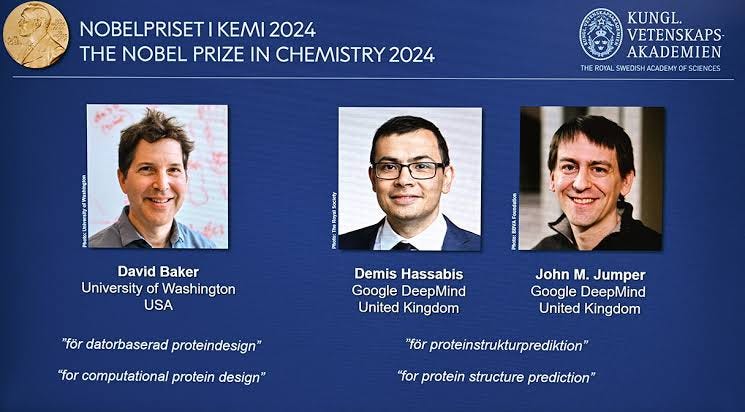
You can see the problem in the models themselves. After AlphaFold 2 answered the question “what is the shape of this protein?”, its successor AlphaFold 3 set out to answer a harder one: “how do proteins bind other biological molecules, from drugs to DNA?”. The model is a solid piece of architectural work and does push the frontier. But, unlike AlphaFold 2, you cannot trust its predictions. Independent analyses show that it has a tendency to memorise and regurgitate its training set, and that it makes egregious mistakes that show a lack of understanding of basic protein physics, such as clear clashes between atoms. The recently released IsoDDE reports real gains on some of the hardest cases, but from the limited information released it feels more like AlphaFold 3.5 than a true step change.
In essence, progress seems to have slowed down.
This is frustrating because far more resources went into these later models. While AlphaFold 2 was a side project at Google DeepMind (its team reportedly wound down), its successors are the whole raison d’être of Isomorphic Labs (amongst many other AI for Bio companies), which has raised $600M and then a further $2B in outside money. Yet, despite orders of magnitude growth in investment, we are getting only marginal improvement.
What went wrong? A lot of people like to point their finger at training data availability. The Protein Data Bank, used to train every AlphaFold, held around 140,000 structures in 2018 and roughly 240,000 today, a rise that shrinks further once you account for how many are near-duplicates of proteins already in the set. The slow growth in structural data is a possible reason for slowdown, but considering the amount of cash in their hands, it is hard to believe data is the true bottleneck. At least, Demis Hassabis has been quite vocal that he doesn’t think data is the problem. If you instead follow the AI world, you might pin the marginal improvements on scaling laws: perhaps training even more powerful models requires inaccessible amounts of compute. And yet, if you estimate the cost of training AlphaFold 2 at about 50,000 A100 40GB hours, or about $80k in 2026 AWS prices, it’s clear that compute is not quite what’s holding everything back. Don’t get me wrong, these are reasons. But they are not the reason.
The thesis of this essay is that the root cause of the slowdown is reliance on coevolution. The fundamental breakthrough in AlphaFold 2 was its ability to mine the evolutionary history of a protein to rapidly explore conformational space. Within a single protein, residues that touch in the folded structure (“contacts”) are constrained to evolve in concert: if one mutates, its partner must often mutate to compensate for it, lest the protein fall apart. The same holds across proteins that must bind each other. So if you align a protein’s sequence against millions of its relatives in genomic databases, these correlated changes capture a faint statistical shadow, left by evolution, of which residues sit close in space. AlphaFold models (and in particular their Evoformer/Pairformer modules) are extremely effective at doing this. The reliance on coevolution, while a powerful prior, also imposes a hard ceiling: because all life shares common ancestors, most proteins are variations on ones the model has already seen, and what looks like understanding is often closer to interpolation among evolutionary relatives. Put another way: the model appears to have learned the physics of biomolecular interactions, when it has largely learned protein genealogy.
I would like to make the case for going beyond coevolution as the main frontier in artificial intelligence for biomolecular modelling. I will do this through three objectives:
map the main ideas that gave rise to the AlphaFold models, which will borrow heavily from my personal memory
discuss where the frontier is today, and what the likely hurdles are
make a few predictions about the future, without fear of any potential embarrassment a few years from now.
Let’s start from the beginning.
The pre-AlphaFold era (~2010-2021)
AlphaFold has become so vital to life sciences that many struggle to remember the world before it, or where its ideas actually came from. But, trust me, they came from somewhere. The breakthrough that felt so sudden in 2020 owed much to a decade of slow, unglamorous progress toward a single idea.
I want to tell that story from the inside, because I happened to be there for part of it. I came to the field in 2017; at the time, I was working with Alán Aspuru-Guzik at Harvard, on generative models that could design tailored molecules according to some properties (some of that work is here and here). We were using generative adversarial networks (GANs, an ancestor of today’s diffusion models, now relatively out of use) combined with reinforcement learning to steer molecules towards useful properties. If you plugged in a solubility predictor, you’d get small, very polar molecules. If you used a melting point predictor, the network would learn to string together long molecules with lots of hydrogen bond donors and acceptors.
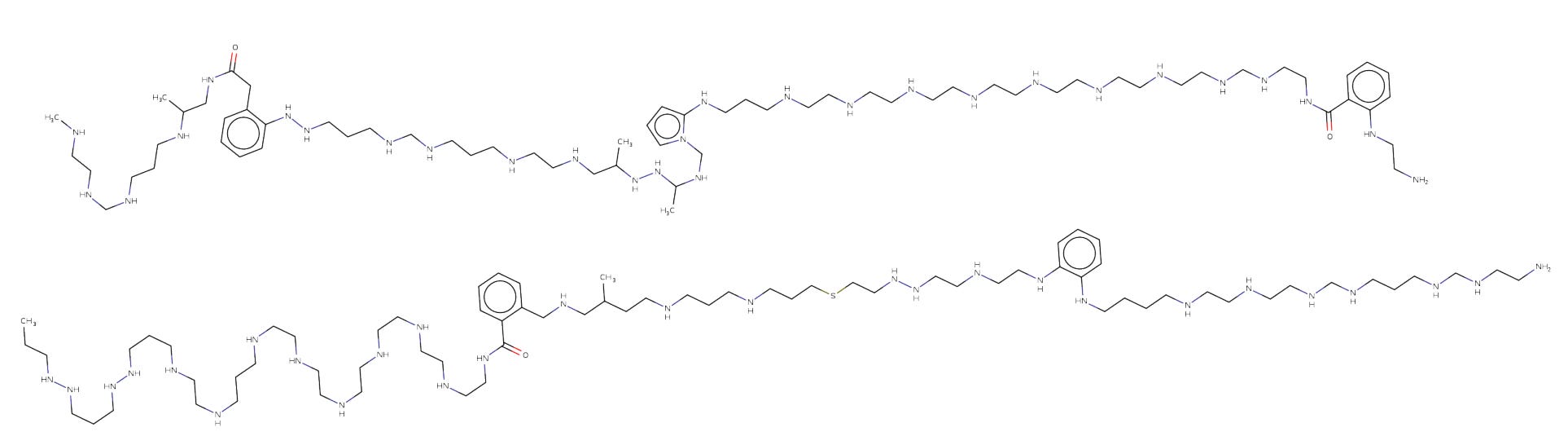
We chose those properties not because they were hugely interesting, but because they were easy to calculate and plug into the models. But what I really wanted to generate were drugs. And drug potency, unlike solubility or melting point, is not a property of just the molecule: it depends on the three-dimensional structure of the protein the molecule is meant to bind. My original assumption was that drug design could be solved by looking up the PDB, running a docking program, and using the predicted binding energy to prompt our system. But, of course, as I explored the problem, it became obvious that for a lot of drug discovery problems the structure that would be the starting point was not even available! For a twenty-something researcher, unburdened by experience, the conclusion was obvious enough: the interesting problem was not the drug. The really interesting question, the one that would occupy me for the best part of the following decade, was: how do you find out the structure of the protein?
At the time, there were two broad ways to predict protein structure. The first, template-based modelling, was not really a prediction at all. One of the central observations in protein structure is that it is extremely conserved across organisms: because the structure determines the function, evolution tries to conserve it at all costs. If there exists a protein structure that was even distantly related to the target (as a rule of thumb, this means ~25-30% of amino acids are identical) you can use the reference as a scaffold and refine it in place. This method works beautifully, of course, because you aren’t as much predicting as copying what already existed.
Far less successful was the other current, template-free modelling, which tried to understand the structure from first principles. These algorithms were inspired by Anfinsen’s hypothesis, which holds that proteins fold to their lowest energy state, transforming “prediction” into an optimisation problem (see the video below for an example of how this was done in practice, with fragment optimisation). Unfortunately, because the energy functions were crudely approximate and the landscape was astronomically large and riddled with false minima, the process was rarely successful. In other words: if you wanted to know a protein’s structure, your only choice was to already know (i.e. have a good template for) the structure of a well-related one!
However, in the 2010s an idea started to arise that made template-free structure prediction much more likely to succeed. The central idea is that pairs of amino acids tend to coevolve in protein sequences. When two residues interact in the folded structure, they are constrained to evolve in concert: if one suffers a mutation, its partner must often mutate to compensate, lest the protein fall apart. These correlated mutations leave a faint statistical shadow of which residues are close in space, and if you can use the right statistical methods to extract it, then you can get a rough blueprint of which parts of the protein are close to one another, and use it to make a strong template-free model. The idea was first proposed in 1994, but the groups that really put it forward were those of Chris Sander and Debbie Marks at Sloan-Kettering, and David Jones at UCL.
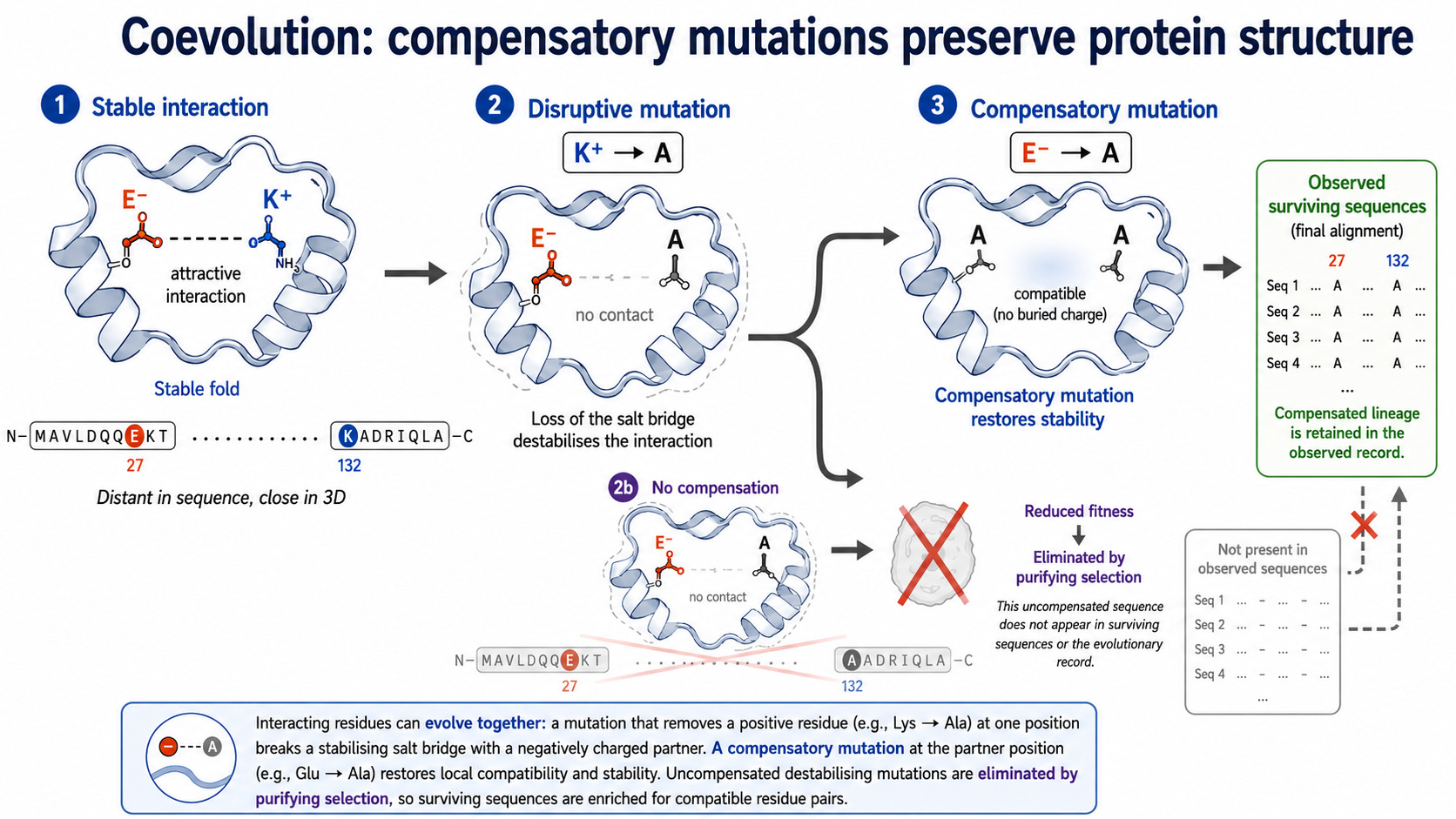
A “contact” is the simplest possible fact you can state about a folded protein: that two residues touch. In the language of structural biology, this means that their beta carbons (or alpha, in the case of glycine) sit within 8 Å of one another. It sounds almost trivially small, but even a handful of long-range contacts is enough to make template-free prediction much more effective, because rather than finding a needle in a haystack you are now choosing between a few plausible ones. The catch, of course, is that you need to predict these contacts with sufficient accuracy.
For a long time, unfortunately, this was barely possible. The trap is that, when you examine a list of sequences, two amino acids can look correlated not because they directly touch, but because both of them interact with a third. The first coevolutionary methods, like direct-coupling analysis (DCA) or inverse covariance analysis (ICA), used heavy statistical machinery (a Potts model, or a Gaussian graphical model) with a complicated inference process to distil true interactions from the noise. While they had a huge impact in the field, they were held back on nearly every front: they were highly dependent on the number of sequences available to build multiple sequence alignments (in fact, some authors have attributed most of the contact prediction in the 2010s to the growth of sequence databases), they were computationally really expensive, and they were underpowered.
Here is when, as someone who lived through the first half of the 2020s, you might be guessing that the solution is deep learning. In fact, since it was a good number of years after AlexNet you may reasonably be wondering “wait, why weren’t they using deep learning already?”.
The truth is that nobody was doing deep learning in structural biology. Ask someone today to name a pioneer of AI for biology and they’ll probably say David Baker — yet the Baker lab’s first bona fide deep learning paper, trRosetta, didn’t arrive until 2019, and could fairly be read as a follow-up to the first AlphaFold. My own supervisor, Charlotte Deane, only picked up deep learning around the time I joined her group in 2018. A few folks were using some sort of neural networks, most notably David Jones’s MetaPSICOV or DeepMetaPSICOV, and Jinbo Xu’s ultra-deep RaptorX1, which set some of the best contact-prediction records of its day. But these networks were feeding hand-built coevolutionary features into a network rather than letting the neural network figure out what to extract from the representation of the model, which is what we would today consider deep learning. The one system that genuinely pointed at the future with deep learning was the Recurrent Geometric Network by Mohammed AlQuraishi which, notably, did not use coevolution at all.
In 2018, a team at DeepMind entered the fray. While the company was well-known from its stints such as training a neural network to play Atari games or defeating Go’s world-champion with a reinforcement learning system, they had a tendency to keep their projects very secret. Years later, over dinner, John Jumper told me that when he interviewed, the group’s leader Andrew Senior wouldn’t even confirm they worked on protein structure prediction. He would only admit, vaguely, that they did “coevolutionary analysis”.
Addendum: 6th August, 2026
John Jumper reached out to tell me the anecdote was not quite as I remembered it. The secrecy part was real: during the interview nobody would admit that the group worked on protein structure prediction, or that they were recruiting anyone to work on it. The coevolution part was slightly different. At his interview, John was describing a piece of his PhD work, using a statistical potential combined with the coevolutionary contact probabilities published by Sheng Wang. Knowing that Andrew Senior came from an audio processing background, he tried to explain it from first principles: how the spatial proximity of two residues leaves a correlation in their evolutionary record. Andrew interrupted him. “Oh, do you mean coevolution?” The term was niche enough to convince John that they were, as the rumours suggested, working on protein structure prediction.
The AlphaFold team came out of stealth at the 13th edition of CASP, the field’s blind assessment of structure prediction, which you can think of as the ARC-AGI of proteins, where methods are scored on structures nobody has seen. Their method used a deep convolutional neural network, acting directly on a multiple sequence alignment, to predict not just the binary contacts between amino acids but the distances between every pair of residues. The result left no doubts: by fusing coevolution with genuine deep learning, that first AlphaFold pushed template-free prediction further in one CASP than the field had managed in a decade2.
The zeitgeist is best captured in this beautiful blog on CASP13 by Mohammed AlQuraishi, one passage of which has stayed with me for years.
Taken together the above suggests substantial progress, more so than usual, and hence not only did AlphaFold “win” CASP13, but did so by an unusual margin. Great! Does this mean the problem is solved, or nearly so? The answer, right now, is no. We are not there yet. However, if the (AlphaFold-adjusted) trend in the above figure were to continue, then perhaps in two CASPs, i.e. four years, we’ll actually get to a point where the problem can be called solved, in terms of gross topology (mean GDT_TS ~ 85% or so). Of course, this presupposes that the trendline will continue, and we have no real reason to believe that it will, at least not without new conceptual breakthroughs. Keep in mind that unlike other areas of machine learning, new protein structures are not appearing at an increasing rate, and so waiting things out will not help.
I remember the months after CASP13 as some of the most vibrant the field has experienced. Perhaps that’s the nostalgia of a junior PhD student at beautiful Oxford, right before a global pandemic kept me locked up for some of the best years of my life. But something had shifted. Teams everywhere were building on AlphaFold’s ideas. And above all, deep learning had become cool: everyone wanted to apply it to biology. What none of us quite grasped was how far this single idea would carry; or where, in the end, it would run out.
The AlphaFold 2 era (2021-2024)
When I talk to non-experts about “AlphaFold 2”, they often get confused. For most people there is only one AlphaFold, the one John and Demis received the Nobel for. The first AlphaFold has become a technical footnote of interest only to field experts, and understandably so, because AlphaFold 2 changed everything.
And I mean that literally. Do you remember the jolt when models like Claude Opus 4.5 first became good enough to hand real coding work to? Take that feeling and multiply it by a hundred. And unlike a model that was merely fast or fluent, back in 2020 AlphaFold 2 did something that should have been impossible: producing the structure of a protein, with high confidence, in a matter of minutes.
AlphaFold 2 was announced in November 2020, at CASP14, the same blind assessment that its predecessor had shaken two years earlier. Except this time, rather than being a competitor… it made organisers question whether the assessment needed to be carried out ever again.
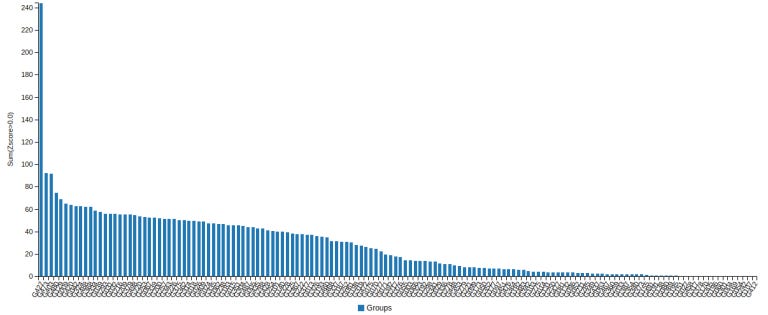
The numbers were almost embarrassing. On the hardest targets, the ones with no template and no close relatives, AlphaFold achieved a near-perfect score. Two experimental groups, comparing the predictions against their own data, realised it was their data they had misread. A third, who had spent two years unable to crack a structure from their crystallography, solved it in an afternoon by molecular replacement once they had a prediction to work from. John Moult, who has watched this assessment since 1994 and is not a man given to hyperbole, said the problem could, in a meaningful sense, be considered solved.
I have a reputation, in more than one circle, as a skeptic. I have spent my professional life wincing through grifter after grifter promising that their model would change the world. So let me be entirely upfront: this was the greatest scientific advance I have ever witnessed. Every single reasonable person I have spoken to in the field would say the same. Having been one of the reviewers of the AlphaFold 2 paper is a fact I intend to tell my grandchildren.

I don’t think this piece is the right place to talk in depth about the architecture, or the science, because I already wrote about it when the model was published (and I have some outdated lecture notes!), as did other experts of the field. Instead, I would like to focus on the consequences of the release. I will keep to the basics needed to follow the rest of the essay. The model can be conceived as two main parts. The first, the Evoformer, is a pair of communicating transformers that extracts coevolutionary information from the multiple sequence and uses it to build an abstract, latent representation of structure. The second, the structure module, takes the refined representations and turns them into coordinates. The two modules work in unison through recycling steps. The final output is a full 3D structure of the protein, including side chains (which are added post-hoc by predicting torsion angles with an accessory network).
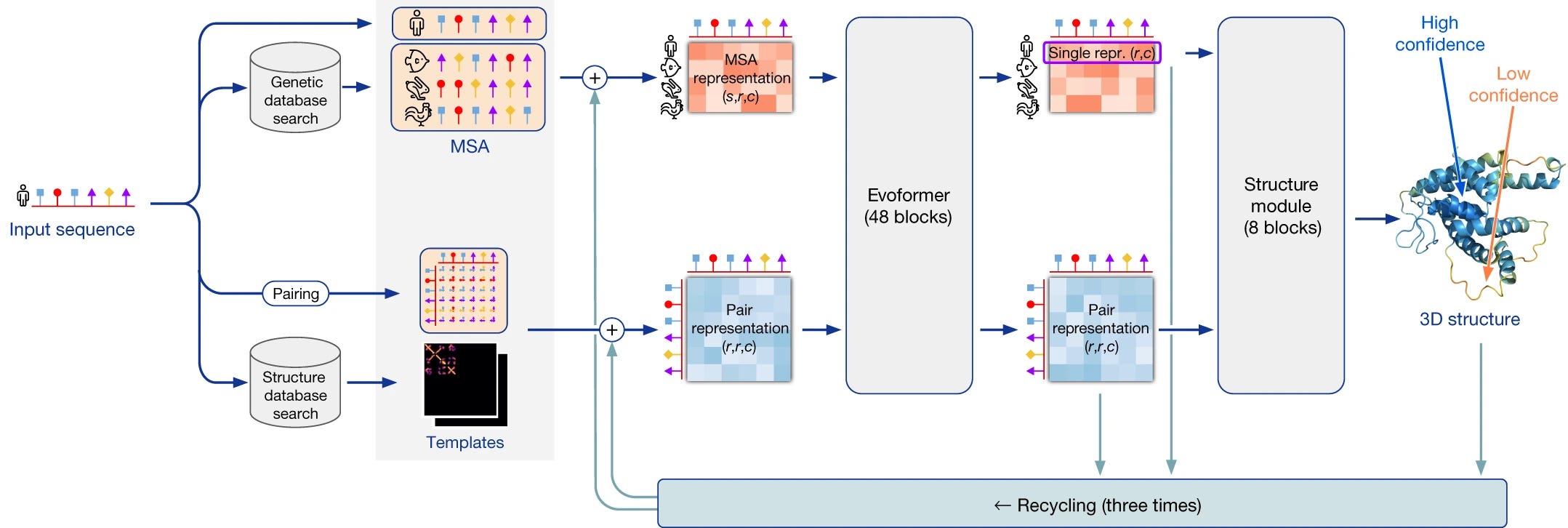
The paper was released together with a 60-page supplementary information describing every method in intricate detail, alongside full inference (but not training!) code. This format started a tradition that machine learning in biology has followed ever since: the main text became a demonstration of capabilities, while the really interesting content, in far more detail than is conceivable for standard scientific manuscripts, is relegated to the Supplementary Information. More importantly, it answered the questions of a field that had spent over six months wondering whether the AlphaFold team would release the model at all.
And the moment the code was released, the field began to play. Within days, people on Twitter noticed you could trick the model into predicting protein pairs, simply by feeding it two sequences separated by a large gap, or a glycine linker. That trick worked because the model had quietly learned something it was never built to do: read coevolution between chains, not just within them. DeepMind followed shortly with a proper version, AlphaFold-Multimer. It was the first hint of how much signal was hiding in those alignments.
It was, after several years of very slow progress, the opening of the floodgates for computational molecular biology.
Protein structure becomes a commodity
The most immediate consequence of AlphaFold 2 is the simplest to state: protein structure stopped being scarce. What once would cost years and a small fortune now cost a few hours and a few dollars, and, thanks in large part to Sergey Ovchinnikov and collaborators’ wonderful ColabFold, you no longer even had to be a computational scientist to run it. Structure became something you could reach for casually, to play with an idea.
Then DeepMind went further and simply gave it all away. In a companion to their AlphaFold paper, they released the AlphaFold database, which today contains nearly 215M predicted structures across more than one million organisms. There is a scene in the documentary The Thinking Game that follows the “war room” as the team decides to predict and release a structure for essentially every protein in UniProt (1:14:47 in case you are interested). Hundreds of millions of structures, handed to the world, for free.
That sudden abundance set off a small field of its own: new ways to search and mine this ocean of structures (Foldseek), to organise it (the Encyclopedia of Domains), and even to fold it back into the sequence models it came from, as ESM-IF (or, more recently, ESM3) did so beautifully. The abundance of structures has also inspired lots of models, from protein modelling and property prediction (see here for my former PhD student Annie’s work on this!) to, perhaps more importantly, protein design.
Protein design starts to really work
One of the ironic things about AlphaFold 2 is that, even though it was supposed to teach us about existing proteins (and it has!), one of its deepest impacts has been on inventing new ones.
The bottleneck in protein design has always been verifying if a designed protein will succeed. An algorithm can propose hundreds of candidate proteins in an afternoon, but finding out whether any of them actually fold as expected (or at all!) means expressing, purifying and assaying them, which can take months in the best cases, and thousands of dollars. As you can imagine, AlphaFold broke the bottleneck. You could now ask, in silico and in minutes, whether a proposed sequence folds to the shape you intended, and throw away many of the failures before ever lifting a pipette. In practice, this meant that the success rate of designed proteins jumped roughly 10-fold in a matter of months.
That single capability reorganised the field around what you might call the central dogma of protein design: generate a backbone, thread a sequence onto it, and check it folds back. Lots of new methods were created to generate backbones de novo, the most popular by far being RFdiffusion, but with a long tail of competitors of which Chroma is my favourite. These “imagined” backbones are passed to ProteinMPNN, which designs a sequence to fit them, and AlphaFold sits at the end as judge, confirming the sequence folds where it should.
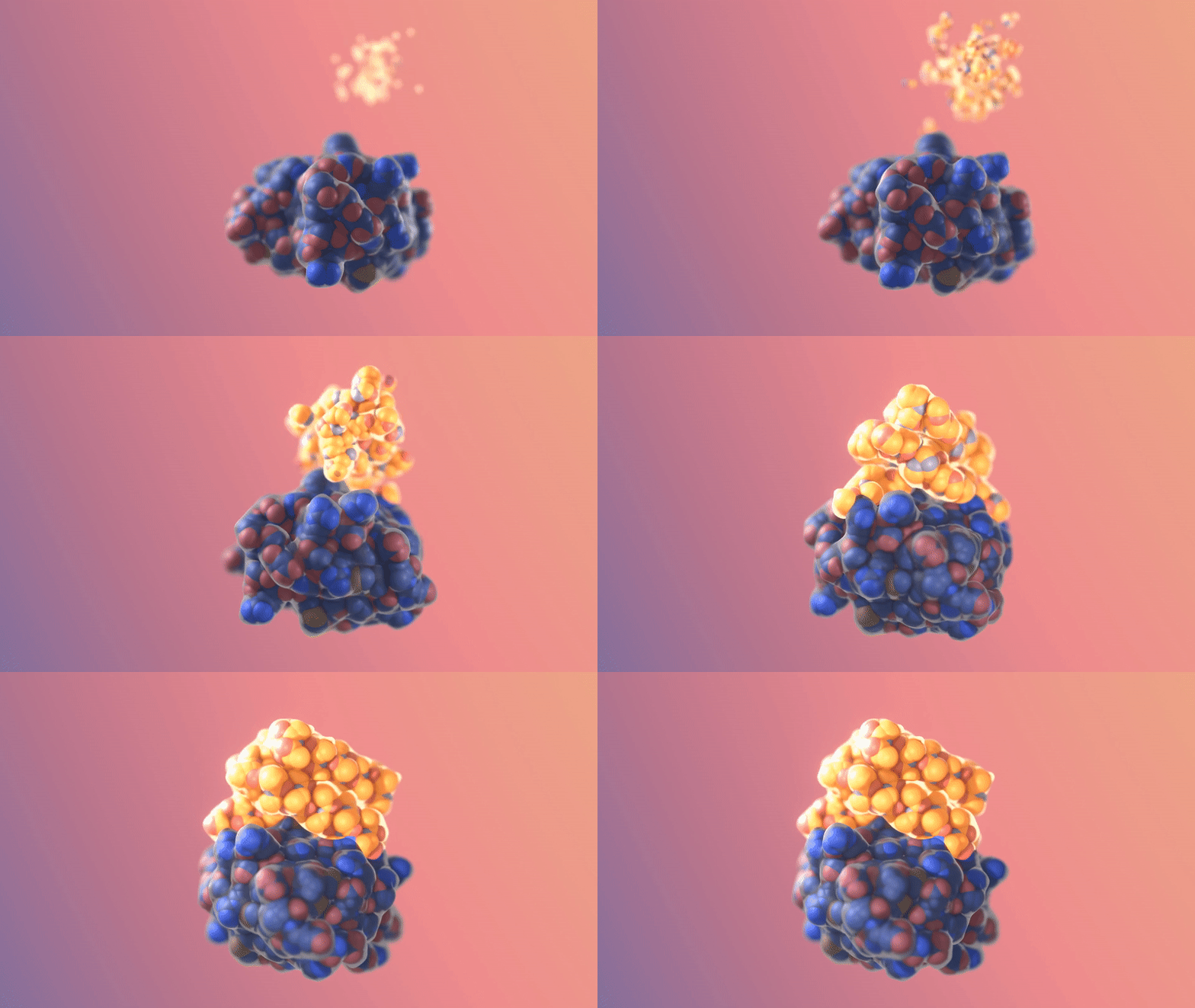
Here is where the story gets really interesting. A designed protein has, by definition, no evolutionary history at all, and therefore no coevolutionary signal to mine. You would expect AlphaFold to be helpless here, but it turns out to be one of the most powerful tools in modern protein design! The reality is that structure prediction is a combination of two problems: a search problem over the astronomically large space of possible protein folds, and a scoring problem that selects the most stable structure. There is a good portion of scientific literature that suggests this is exactly how AlphaFold works: the Evoformer builds a model of the interactions, and the structure module defines which is the right one.
Designed proteins work so well because the first part of the problem can be removed almost completely. Designers build idealised, well-behaved folds with smooth energy landscapes, so the search space converges much more quickly. The structure module then acts like a learned energy function, which is far more powerful than the rudimentary atomistic potentials that we used before. And there are catches, even there. The analysis of designed protein binders in Adaptyv competitions has suggested that the strongest predictor of a successful binder is similarity to structures already in the PDB. Which is to say: we still measure success by resemblance to what we have already seen.
There is a lot that could be written about protein design; I strongly recommend this review by David Baker’s group that highlights all the major achievements in the last few years. For the methodological side, I also co-authored a Current Opinion review on exactly this, led by the brilliant Adam Winnifrith, with Brian Hie.
But the story is not over here.
The AlphaFold 3 era (2024-2026)
The next update to the field was the release of AlphaFold 3 on May 8th, 20243. I will once again omit architectural details (I wrote about it back in the day), but the take-home message is simple: the architecture changed, the paradigm did not. The Evoformer became the Pairformer, the structure module gave way to a diffusion decoder, and the model swallowed a much larger chemical vocabulary. Underneath it all, though, the engine was the same one that powered AlphaFold 2: exploit coevolutionary signal, and turn it into coordinates.
The release itself became a minor scandal. The article was published in Nature, alongside a traditionally detailed supplementary information… but there was no code, nor weights. This led to a small Twitter revolution as the gesture was perceived by many (rightfully so) as a challenge to the basic principles of reproducibility in scientific publishing. Under mounting pressure the team settled on an awkward compromise: code under a noncommercial licence, weights under a licence so restrictive it permits little beyond academic work.
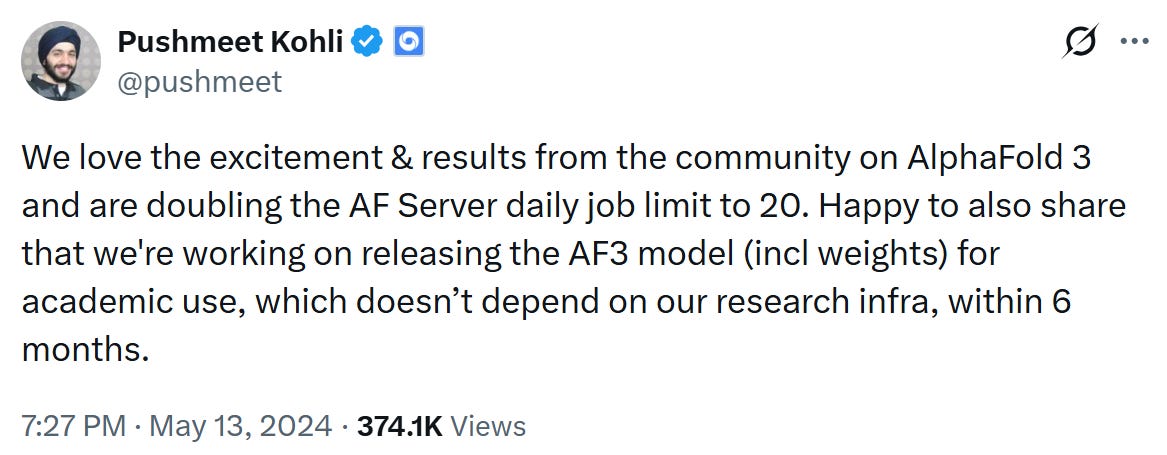
What happened next was, of course, that multiple teams set out to reproduce the model, and did so with startling speed. Within a year there were several near-replicas, differing mostly in how openly they were shared. The fastest were Chai and Protenix, though neither released their weights in the first instance. Much smarter was the move by the folks at Boltz (back then at Regina Barzilay’s group at MIT, not yet a company), who put everything in the open and, by doing so, captured the entire mindshare of the AI-for-biology community more or less overnight. Also open, if a little slower, was the team at OpenFold. While AlphaFold 3 still kept a lead in terms of overall accuracy (though OpenFold is getting closer), within a year there were multiple models that were 90% there.
Beyond the gossip, which of course is fun, the most interesting point is not just how AlphaFold 3 was built, but the new doors that it unlocked. AlphaFold 2 had focused on protein-only complexes, the task where coevolution is strongest. AlphaFold 3 pointed the same weapon at harder ground: how proteins meet other molecules, from DNA to drugs. And because these are the testing grounds where the coevolutionary signal provides less information, here we see the first cracks in the model.
Small molecules everywhere, all the time
The headline capability of this generation is the ability to model small molecules. Isomorphic Labs was not the only player here (for example, Charm Therapeutics had been chasing similar approaches for a while, with less obvious success) but the ambition was shared: put a drug and its target into the same model and predict the pose.
Here is the thing about small molecules: they are far harder than they look. Yes, they are small, and their conformational space is trivial next to a protein’s. But what they lack in size they make up in chemical complexity. There are 20 proteinogenic amino acids (22 if you count selenocysteine and pyrrolysine, the latter found only in some archaea and bacteria), perhaps a few tens more if you include common post-translational modifications like phosphorylation and hydroxylation, and a couple of hundred if you throw in every known one. Small molecules, by contrast, number somewhere around 10^60 drug-like structures. If you count the stranger things the field has taken to building lately (bifunctionals, anyone?), the number is even greater.
They are also far less forgiving. One of the most frequent words in the medicinal chemist’s vocabulary is activity cliff: the phenomenon where two nearly identical compounds show wildly different activity, usually in binding potency. Here is a real example, from a real medicinal chemistry paper. The two molecules in the figure below are part of the chemical series for doramapimod, an inhibitor of the p38 MAP kinase developed by Boehringer Ingelheim for inflammatory disease that unfortunately failed in Phase III. They differ in just a single methyl group. This tiny difference, just one heavy atom, is enough to change the IC₅₀ 250-fold. The structural perturbation that it produces is subtle: it twists the two rings out of plane, forcing the molecule into a shape that somehow fits much better into the pocket.
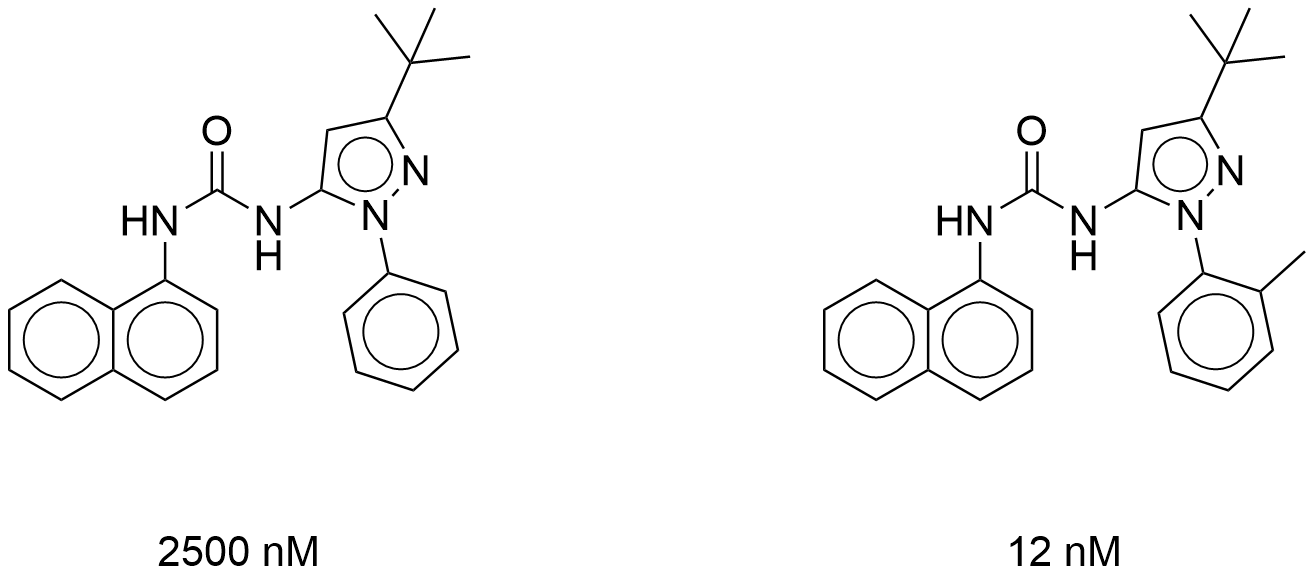
Here is the worrying part: this difference should be easy to explain if you have structural methods. A good medicinal chemist can look at the structure and rationalise how the methyl group might change the torsion of the molecule and reduce the strain of the molecule in the pocket. Classical computational modelling with physics-based methods can reproduce the torsion, and even estimate the affinity difference with good accuracy. And yet, AlphaFold-like models cannot even predict how the pose changes (perhaps unsurprising, since they also can’t predict what happens to the pose if you remove the pocket).
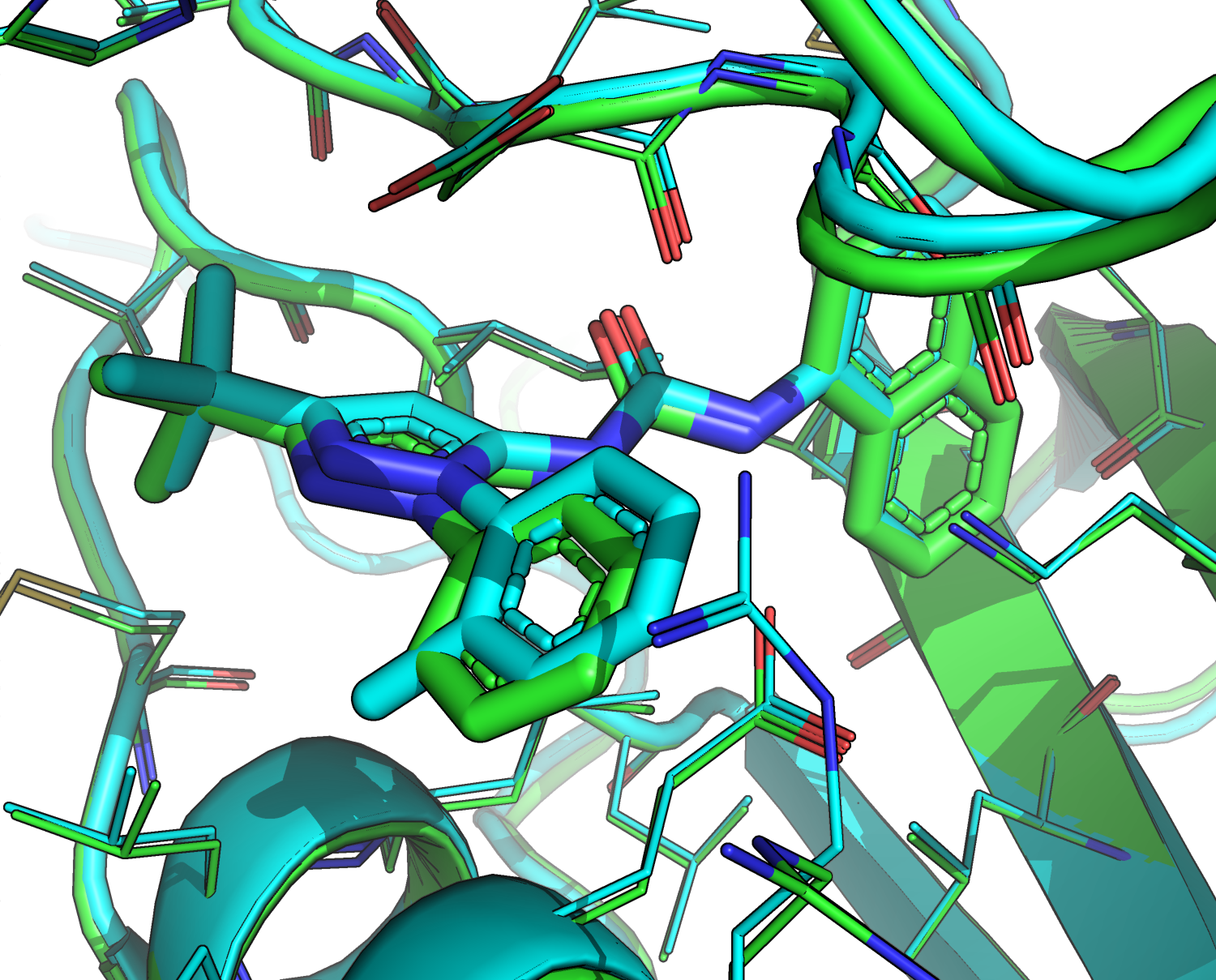
These results shouldn’t be surprising if we remember that AlphaFold-like models are interpolating machines that work by extracting coevolutionary information and turning it into structure. In the small-molecule world, there is no coevolutionary information to extract. In fact, a large portion of the success of cofolding methods has been attributed to their ability to locate binding sites, which are known to be well-encoded in coevolutionary representations. A drug has no evolutionary history, no genomic relatives, no alignment of millions of variants with a hidden signal whispering which residues sit close in space. You also can’t understand a molecule by its analogues, because even single-atom changes can cause dramatic changes in behaviour. In a world where you had access to lots of counterfactual experiments (very similar molecules with small changes, and matching crystal structures and measurements), then it might be possible to get the models to learn some physics. Perhaps this will work once some model developers gain access to the internal databases of private pharma companies, where there is a wealth of protein-ligand structural and assay data. But today is not that day.
The one result that certainly wasn’t on my bingo card is that the problem seems much easier to solve in the other direction. It appears easier to design a protein that binds a small molecule strongly than to predict how a given small molecule binds a given protein (see here and here). That might sound backwards, but reminds us of the lesson from designed proteins: when you get to build an idealised, well-behaved binding site from scratch, you are no longer fighting the model’s blind spots, but are playing to its strengths.
Antibodies become designable, all at once
This section grew into an essay of its own, The antibody revolution is real, so I will keep it very short here and point you there for the full story.
The short version is that AlphaFold 3 solved the problem of designing new antibodies, which had been a long-standing field problem. In 2023, AbSci reported the first generative design of antibodies, which turned out to be a flop. Barely two years later, four frontier companies (Nabla Bio, Latent Labs, Chai Discovery, and Xaira, the last under David Baker’s wing) independently reported models that design antibodies de novo at high-single to low-double-digit success rates, several of them without a single round of optimisation. A frontier problem became, in the span of a few months, something of a commodity.
The AlphaFold 3 architecture has likely been one of the differentiators. In the original paper by David Baker’s group reporting atomic design of antibodies, they observed that AF3 itself could achieve an AUROC of 0.86 (using just AF3’s internal confidence metric) to predict which antibodies were successful and which ones weren’t.
The fact that AlphaFold 3 can work with antibodies so successfully is worth some thought. Antibodies are the cleanest example in protein biology where coevolution does not help. The sequence of antibodies arises from a combination of gene recombination and somatic hypermutation to maximise variability, which means that there is not a source of evolutionary information that can be exploited. And yet (and this is the pattern, again) the vast majority of antibody design has restricted the structure significantly, needing to predict only a handful of loops. My read is that AlphaFold’s learned energy function (as crystallised in the diffusion module) is simply powerful enough to elucidate the best conformation when the search space is sufficiently small.
The next frontier (2026-?)
And now, here is today. The methodology has stood roughly still since AlphaFold 3. There are still a few people innovating on the architecture: for example, Minkyung Baek, first author on the RoseTTAFold paper, has published work on alternatives to the standard recipe; and the AlQuraishi group put out Genie 3 (not to be confused with the world model that shares the name). Others, like Apple’s team, have demonstrated that you can make the architecture even simpler, just a small variation of the transformer. But these are variations over an existing piece, rather than a completely novel melody.
One might expect that DeepMind (or Isomorphic Labs, which feeds from very similar people) would once again update the field with a new model architecture. The closest thing we have is the recent IsoDDE release, which is AlphaFold 3.5 in all but name. The authors offer little information about the architecture (though they hint that it remains close in spirit to AlphaFold 3), but they show that on the hardest, most out-of-distribution cases, it roughly doubles AlphaFold 3's accuracy. One can hypothesize that a lot of the changes may derive from the army of computational chemists that Isomorphic has spent the last two years hiring, as well as their own proprietary data. From the outside, it is impossible to tell how much of this performance increase is due to the model and which one is to the data. All in all, it seems like IsoDDE is an incremental improvement rather than a step change.
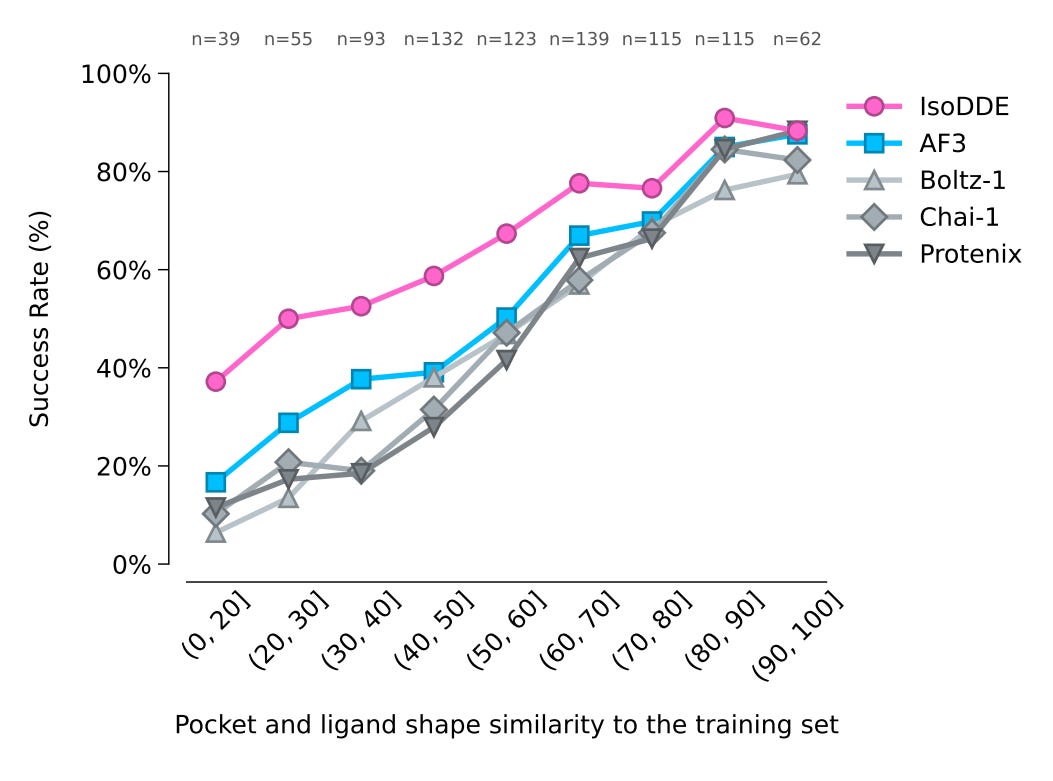
The field is also stalled in answering many of the crucial questions about how biomolecules interact, that go beyond simply predicting the crystal structure.
One, for example, is protein dynamics. Even if most of our understanding of proteins comes from samples at -200 °C, proteins are not rocks. They flex and flip between conformations, and a lot of valuable functions depend on these conformations. Ever since AlphaFold 2, people have been trying to trick the models into generating ensembles of structures, for example by perturbing the MSA, or more recently, by manipulating the latent space. The most mature line of work is the Boltzmann generators pioneered by Frank Noé and others (Frank has since gone to Microsoft AI4Science and built BioEmu, among other lovely things), which try to learn the equilibrium distribution of a protein directly from lots of molecular dynamics simulation. The catch is of course that they inherit every defect of molecular dynamics itself, including the very approximate nature of energy functions. Today, I do not think we have made real progress on the ensemble problem at all, not solely because of the methods, but perhaps even more because there are no good assessments with reference data to keep us honest.
That, by the way, also applies to protein folding. No matter how much DeepMind claims it, or how many press releases suggest it, AlphaFold has not solved the protein folding problem, only the protein structure prediction problem. The folding problem is a different beast entirely, asking how the protein chain gets to that structure, with enormous implications for both basic and applied science. The distinction is not pedantic. I became rather obsessed with it during my PhD (the paper is here), to the point of building a small benchmark out of the pitifully few experimental examples we have of folding pathways. You can mine a billion sequences and never recover the order in which a chain zips itself together, because that order left no signal in the sequence record.
So, we seem to have a stalemate. Does anyone have any idea how we are going to make progress? Well, here are some.
Prediction 1: physics will be more and more important
The entire premise of this essay can be summarised in a sentence: nearly every success in the last decade can be attributed to the power of coevolution. The whole field owes an enormous debt to a few pioneers (David Jones, Debbie Marks, several others). However, as we seem to have exhausted coevolution, we need to start looking elsewhere.
The problem with coevolution is that it only carries information in some situations. The strongest coevolutionary signals come from an individual protein, because this is highly conserved. Protein-protein interactions come close behind, at least when the interaction between the proteins is sufficiently conserved such that coevolution has imprinted the sequence record. However, there is far less information when we talk of protein-DNA, and essentially none when we talk of protein-ligand interactions. When we are lacking that information, we need to endow the models with new capabilities that extend beyond, much like modern LLMs have learned to use tools to expand their imperfect information corpora. In protein science, that toolkit is physics.
I am not arguing that the current models do not know any physics, by the way. There is a beautiful paper by James Roney and Sergey Ovchinnikov that shows how AlphaFold 2 gets an idea of the energetics. There is also anecdotal evidence that AlphaFold 3 can make some astounding, physically reasonable predictions, such as the structure of electrolyte solutions, or the assembly of membrane systems. And yet there is also lots of evidence that nearly all known protein or ligand structure models have a tendency to violate the most basic laws of molecular physics. Famous already are the decoys generated by models like DiffDock that defy the very rules of chemistry.
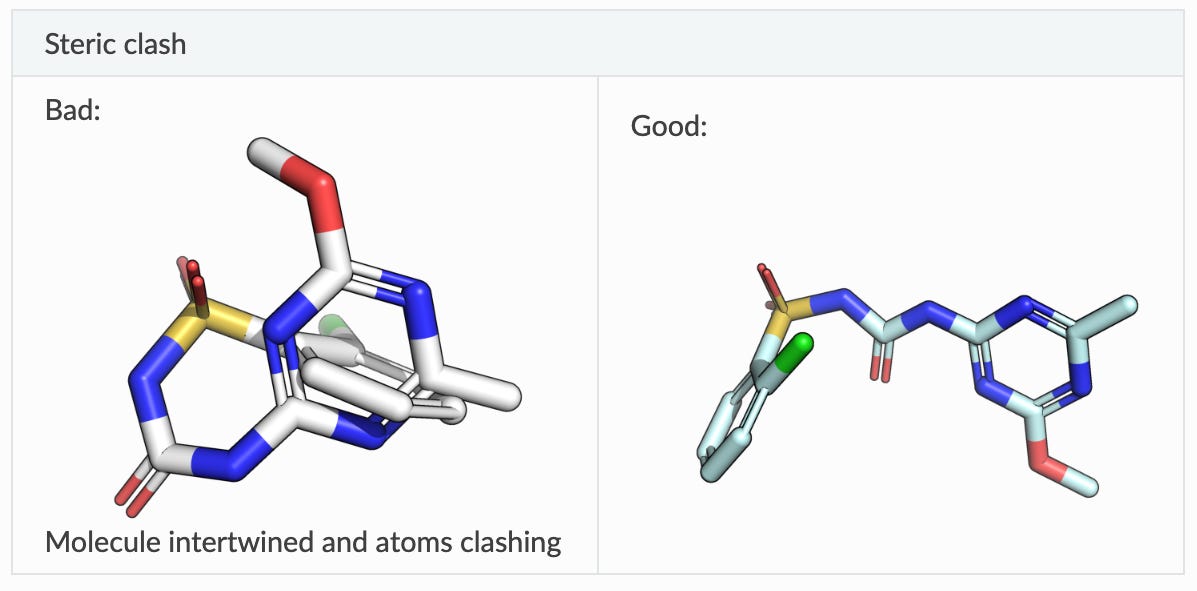
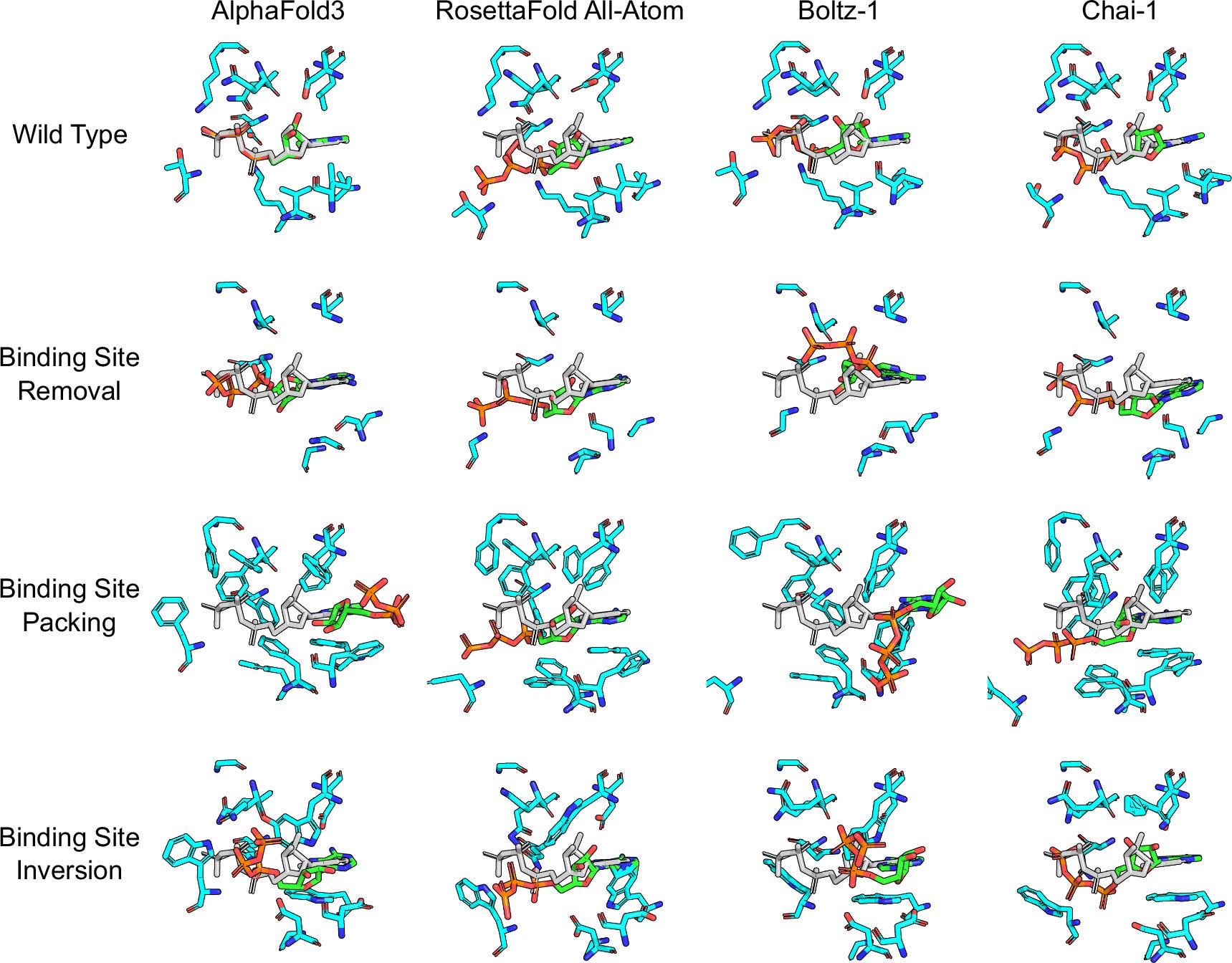
The failures become even worse when you look at the AlphaFold 3 class of models. One of my favourite papers of last year tested the leading cofolding models against extremely simple adversarial examples. For example, they took CDK2, with ATP bound, and mutated every single residue in the pocket to glycine, effectively deleting the side chains that anchor the triphosphate. And yet, all four models tested in the paper (AlphaFold 3, RoseTTAFold-All-Atom, Chai-1 and Boltz-1) place ATP exactly where it was. When the authors instead mutated all residues to phenylalanine, so that a conglomerate of aromatic rings physically fills the pocket, the models still kept the ligand in the pocket despite the enormous steric clashes.
People are thinking how to fix this, and there are a few ideas out there. For example, the guys at Boltz introduced a physical steering process. Their Boltz-2 model can use Feynman-Kac steering (which is a very fancy way of saying, they constrain the denoising steps) to make sure that the structures are physically realistic according to a classical force field. This helps to reduce mistakes such as steric clashes, but it is still not enough to tell the model not to put the ligand inside of a pocket with only glycines.
I envision physics entering these models the way tool calling helped LLMs. Not long ago, if you asked a language model to multiply two large numbers it would give you a stupid (not just wrong) answer, because it was matching over text rather than computing anything. The solution was to grant it access to a calculator. Cofolding models are in a similar space: they can generate plausible structures, but have no way to use physics to understand which of those structures make sense. Unfortunately, I don’t think the solution is as simple as plugging in a physical model (these are very limited in molecular biology, at least). But I am confident that novel ideas that get the models to better understand the priors of the laws of physics will result in better predictions across the board.
Prediction 2: biological data will play an increasingly important role
The open frontier in biological AI is, and has always been, data. The lesson seems to have been learned quite well in neighbouring areas in cell modelling, with enormous amounts of data. There are many companies collecting massive datasets on cell perturbations (e.g. Tahoe, and at least some of the work that Xaira is doing) or tissue samples from patients (e.g. Noetik, Relation, etc). The need for data in the cell biology world is far from forgotten. Somehow, in the more molecular-centric world there has been less of a desire to collect “machine learning-grade” data. However, they are not alone.
One of my favourite companies is Leash Bio, a company that is using DNA-encoded libraries to generate the world’s largest dataset of protein-small molecule interactions. The company’s journey has been the subject of an incredible blog post by The Owl Posting that I would recommend to anyone in the field. There are a few problems with this technology, however. Because of the way that DNA-encoded libraries work (tag, enrich, deconvolute with DNA sequencing), the information is very binary: you know if the small molecules bind or not, but it is hard to infer a quantitative affinity readout that tells you which molecules bind more strongly. You also don’t get any structural information. And, because the DNA tags are tethered to the molecule, there is a fair number of false negatives simply because clashes with the tag preclude binding.
An approach that is likely to be more successful is OpenBind, which is based around the high-throughput X-ray crystallography technology at the UK’s national synchrotron, Diamond Light Source, at Harwell. Their objective is to collect, over the next five years, the largest open dataset of protein–ligand structures ever assembled: on the order of a couple of thousand new complexes a week at full scale, using robotics to soak crystals directly with reaction crudes. Most importantly, every structure will also come with affinity data attached.
Another is A-Alpha Bio, which has a high-throughput yeast display system to measure protein-protein interactions. The team has been using their platform intensively for antibody design (well-suited, because yeast display operates in the exterior of the cell, it captures a lot of the environmental factors important for antibodies such as oxidation state, etc). As I was editing this piece, they announced a partnership with GSK, Boltz, Cradle and Dyno Therapeutics, to generate data to power biomolecular AI models.
I believe that these approaches are all going in the right direction: generating data that fills in the gaps left by coevolution. However, something that I have learned in many years in the field is that data quality and data abundance are often at opposite ends. I have also learned that consortia can start with incredible momentum and soon fade as interest (or grant money) runs thin. I don’t think that the question of generating the right data is quite solved.
Prediction 3: progress will stagnate because of siloing
I have been in the field long enough to remember the time of stagnation. Remember that for nearly a decade between ~2000 and 2010, our protein structure prediction abilities remained roughly unchanged. In the following decade, until the AlphaFold breakthrough, the little progress that was made happened one CASP at a time. Because every group wanted to be the one to come out first, progress updates were withheld until the biennial assessment, and the participant groups were forced to independently rediscover the wheel over and over.
Now, imagine if the information wasn’t shared at all. A lot of the field’s progress in the last few years has stemmed from DeepMind/Isomorphic’s releases providing a “gradient update” to our architectural understanding. Unfortunately, Isomorphic Labs seems to have learned from the AF3 fiasco and has decided, at least for their latest IsoDDE model, not to put out any more information than necessary.
The problem is likely to get worse. One of the recent headlines was of Isomorphic Labs raising over 2 billion USD, taking the total amount of funding they secured in just over a year to well over 2.5 billion dollars. Together with some of the other funding rounds recently e.g. Xaira’s 1 billion dollar seed, and Chai’s recent 400M USD round, it is clear that there are many players with extremely deep pockets. This, by the way, makes complete sense4: these huge raises enable them to focus on progress without the distractions of constant fundraising, especially in a field like biotech where it is crucial to have multiple shots on goal. However, this will also lead to another issue: talent concentration.
Think about what is happening in the natural language world: nearly all the frontier research is being carried out inside private corporations. While it is well-known that research secrets in the Bay Area travel like a cough in flu season, this is a consequence of the particular legal structure of California competition law. In biotech the same conditions do not hold. The money is spread across jurisdictions where non-competes are perfectly enforceable, and the culture is built around patents rather than preprints, because the key output (the only output that ultimately matters) is the drug. If enclosure in language models is porous, in biology it will not be.
So my third prediction is a paradox: more money than the field has ever had will lead to less progress per pound than it has ever managed, because the ideas that would compound stop moving between the people who have them.
Conclusions
AlphaFold 2 is the greatest scientific advance I have witnessed in my career… which is not something I expect to say about any model for a long time. However, five years after the Nature paper was published, and having witnessed two new generations of the model, I have been worrying that the field is reaching a stalemate. The problem is that coevolution, the single idea underpinning the technology, has given us nearly everything it has to give.
Coevolution was a gift: evolution spent four billion years running an optimisation experiment on every protein, and left a faint statistical shadow in the sequence record. The genius in AlphaFold was learning to extract this information from multiple sequence alignments, and transform it into a protein structure. But the same success that made the model excel at protein structure prediction is not providing the information that it needs to excel. Like a tourist with a phrasebook, it often produces useful sentences; but it also fails disastrously at grammar.
There are, as far as I can see, only two paths to success. One is to teach the models the physics that they need. They would need to understand enough about the physical world to avoid making atoms fatally crash, while retaining enough of its latent space behaviour to excel at the task; kind of like humans, navigating between a system 1 and a system 2 and using the best of both worlds. Unfortunately, this is something that has been preached for years but never achieved in practice. The other is to generate, deliberately and at industrial scale, the data to fill in the gaps left by evolution. Data of multiple sorts, including structural as well as energetic data. Unfortunately, that data does not come cheap.
Coevolution took us further than anyone in 2017 could have dared to imagine. Here, I have argued that it took us as far as it can. The next breakthroughs in AI for proteins belong to those who break the barrier.
For brevity reasons, I have omitted some of the story with regards to deep learning appearing around CASP12 (2016). In that edition, Jinbo Xu’s RaptorX method, which used a convolutional neural network to predict protein-protein contacts, achieved the best performance, and was shortly followed by similar methods like David Jones’ DeepMetaPSICOV. These methods were predicting binary contacts i.e. predicting which residue pairs were within 8 Å of one another. Jinbo Xu also published the first (as far as I know) neural network predicting protein distances, rather than binary contacts, which did very well at CASP13 (2018). Despite the deep impact that all these contributions had on the field at that time, I have chosen to omit these details to simplify the story.
John Moult, who founded the assessment, would frown at calling it a “competition”, so I will refrain from saying AlphaFold “won”.
I remember the date with some accuracy, because it is my birthday.
For the companies. For the investors… we’ll see.
Protein structures are nor solved by AlphaFold 1,2 or 3 they are predicted
Great stuff thanks!